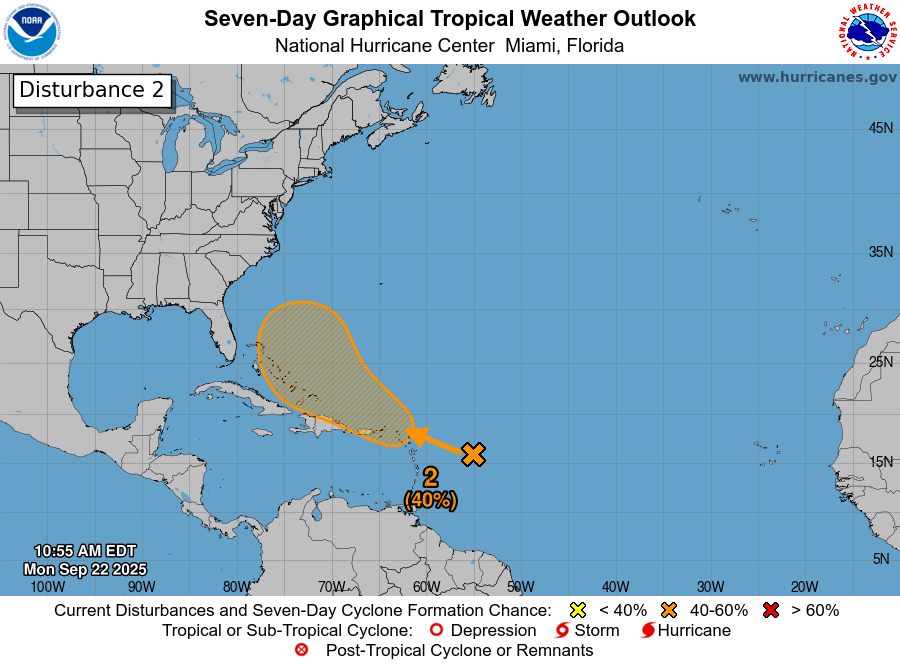
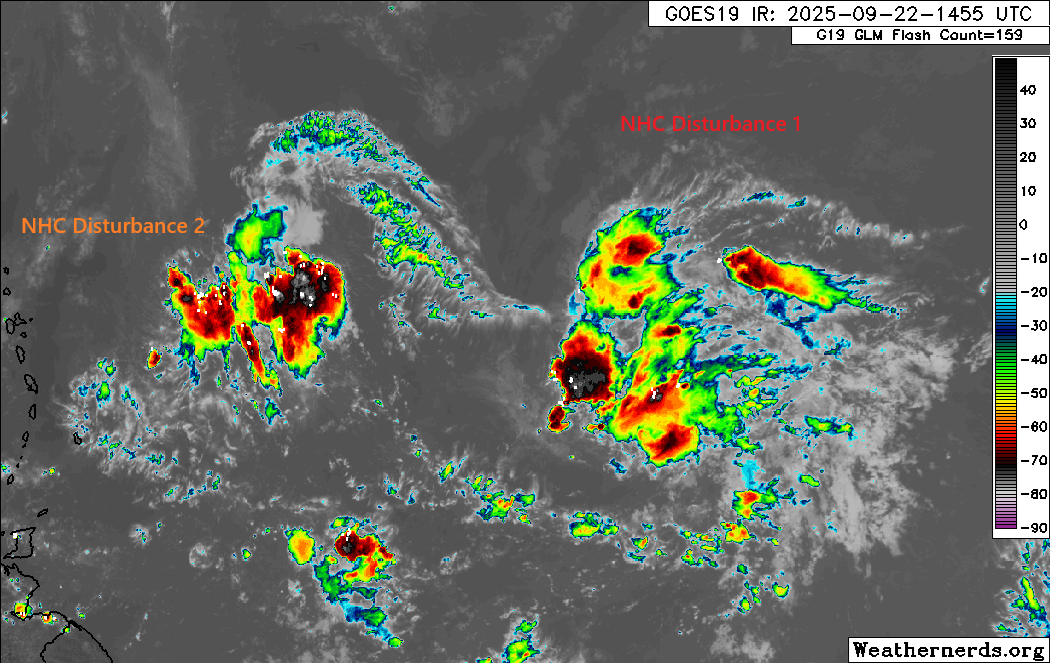
Erin begins to exit stage right but not before prompting a few more concerns in Atlantic Canada

In brief: Erin is chugging out to sea now, but not before possibly delivering an enhancement to already extreme wildfire risk in Nova Scotia, New Brunswick, and Prince Edward Island. Rough surf and rip currents will linger on the East Coast and in Atlantic Canada through Sunday. Invest 90L remains worth monitoring for Bermuda. Invest 99L is worth monitoring for the Windward Islands. And flooding chances mix with beneficial rainfall heading into next week in the southern Rockies and Plains.

Hurricane Erin

(NOAA/NHC)

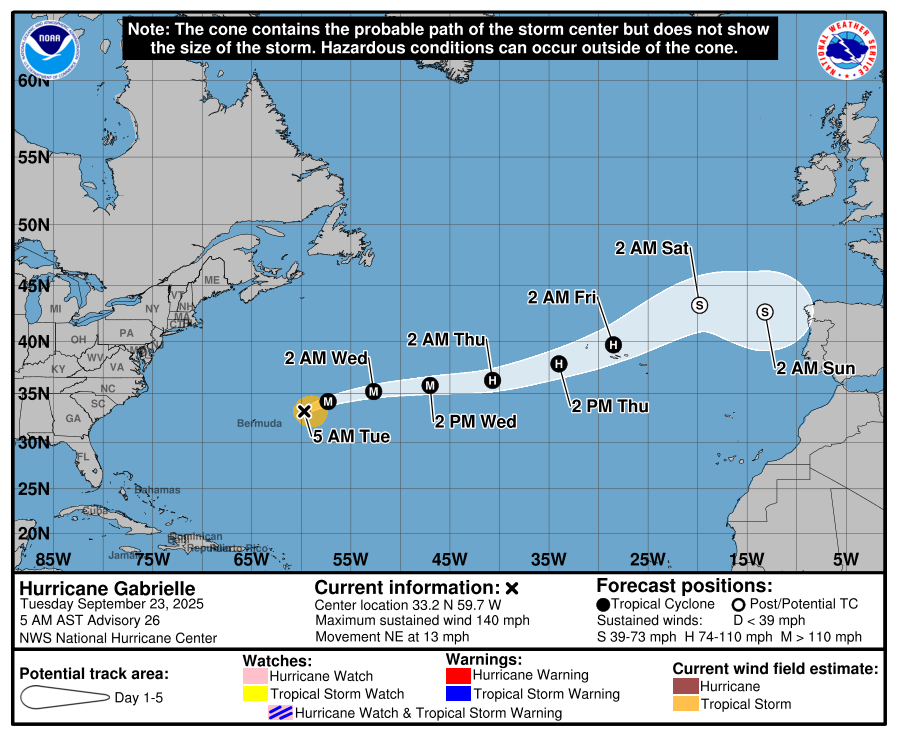
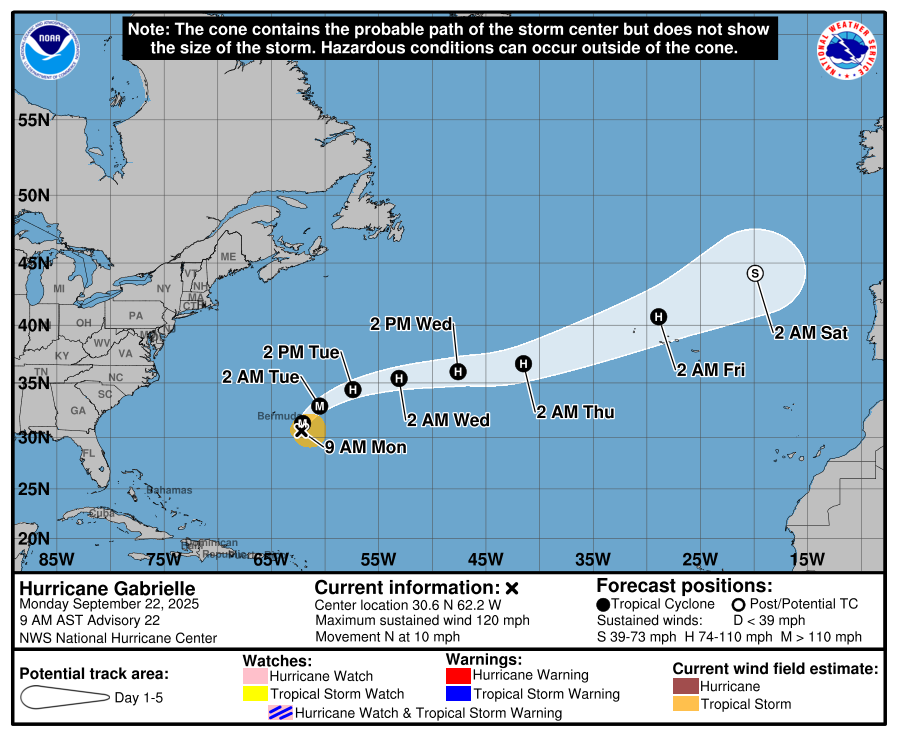
Erin is booking it this morning. The strong, sprawling category one hurricane is moving northeast at over 20 mph. The good news this morning is that all watches and warnings for land have been discontinued. Rough surf and rip currents will continue to impact the East Coast, Bermuda, and Atlantic Canada, but the worst of Erin’s impacts to land seem to be over now.

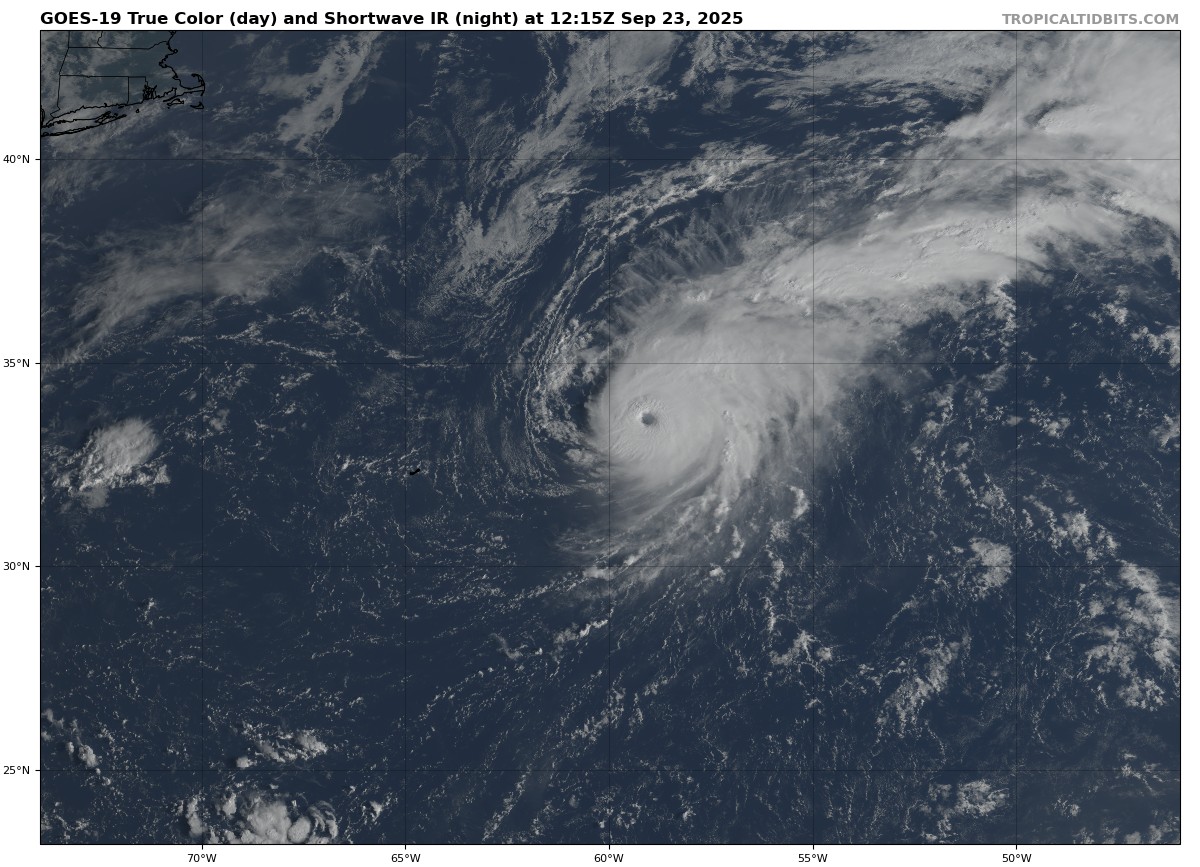
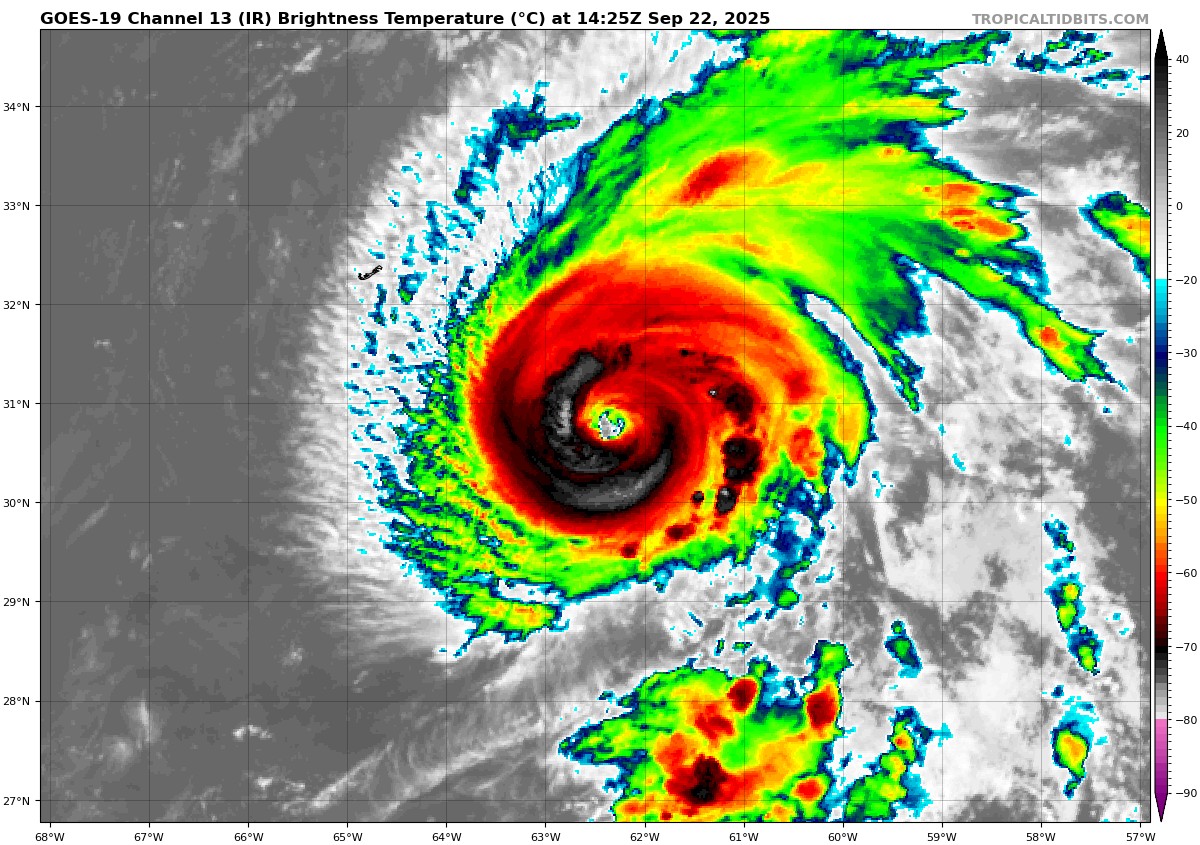
Erin looks like a hurricane that is beginning to undergo extratropical transition, except it’s gigantic. (Weathernerds.org)

What’s next for Erin? Well it remains a large storm, with a wind field of tropical storm-force over 350 miles now. It should pass well south of land, but gale-force winds are likely in southeast Massachusetts, Nova Scotia, and the Avalon Peninsula in Newfoundland as this passes. Rough surf with waves of 3 to 6 meters may break on the coast of Nova Scotia today and in the Avalon & Burin Peninsulas of Newfoundland later and tomorrow. Even as Erin weakens and turns extratropical in the cooler North Atlantic waters, the size of the gale-force wind field may grow further, keeping Erin a powerful feature on the weather map through the weekend.

Yesterday I noted the wildfire potential with gusty Erin winds blanketing a very dry Atlantic Canada. Well, the fire risk today at least seems pretty noteworthy in Nova Scotia, PEI, and parts of New Brunswick, with “extreme risk” drawn in those areas.

Extreme fire risk for much of Atlantic Canada outside of Newfoundland today. (Natural Resources Canada)

That risk should remain and expand into Newfoundland tomorrow. For some areas, the risk may diminish as Erin passes, particularly for Newfoundland. In Nova Scotia, New Brunswick, and PEI, however, the risk may stay at extreme levels through the entire weekend. A rare situation for this part of the world.

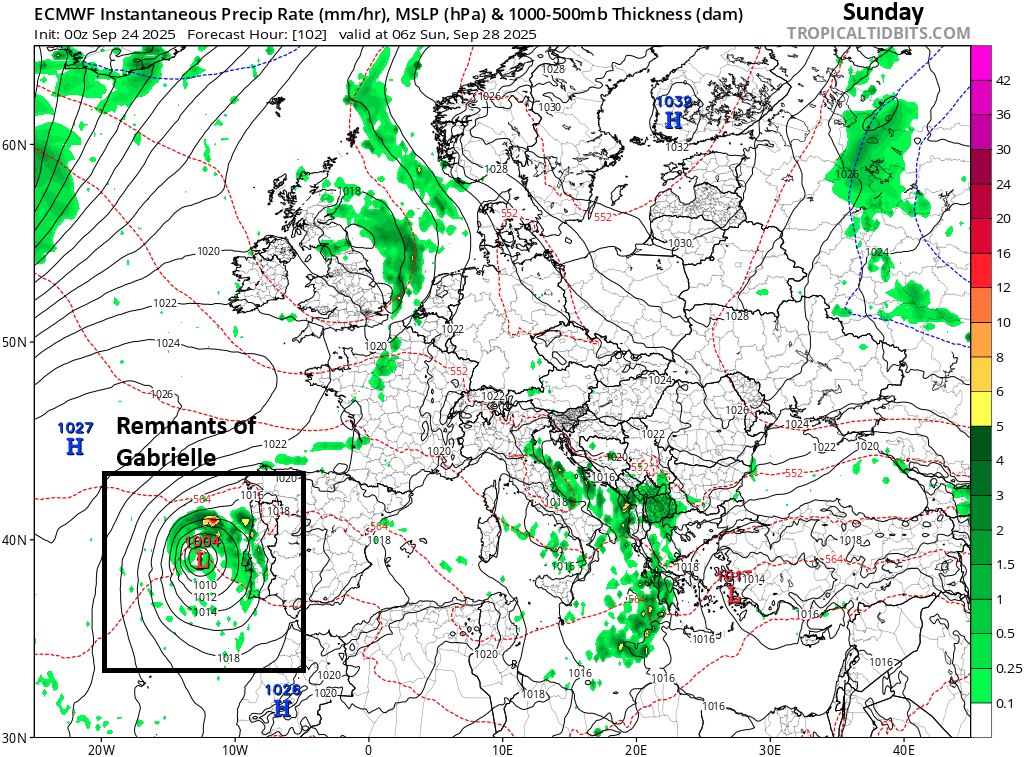
Erin’s remnants will park themselves south of Iceland for a time before probably moving into Europe as a (much weaker) storm next week.

Invest 90L

Let’s work our way back south now to Invest 90L. This one continues to lack much organization today, but models continue to insist it will eventually get its act together.

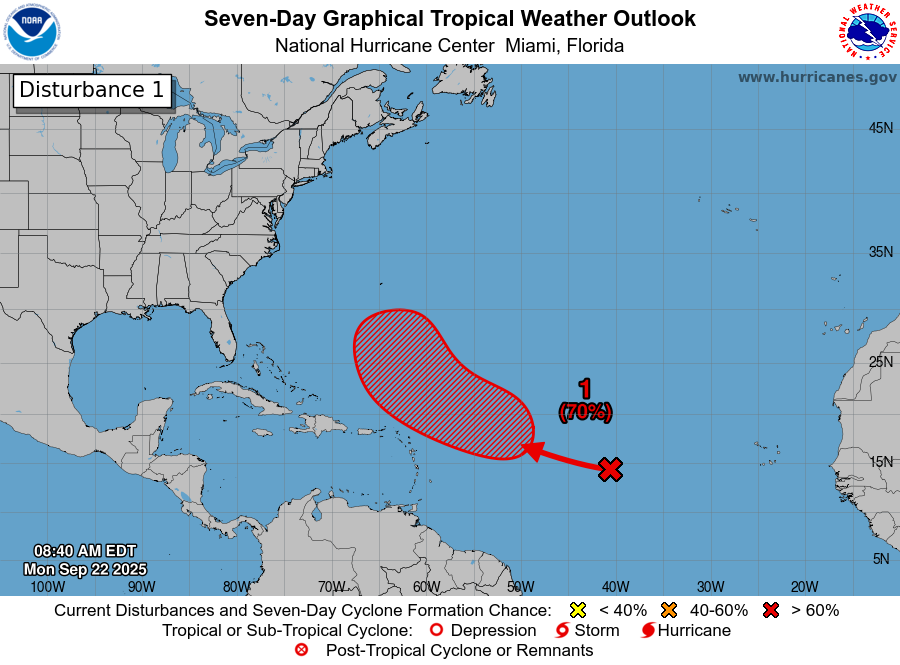
Invest 90L has very broadly disorganized thunderstorms, but that’s it at this point. (Weathernerds.org)

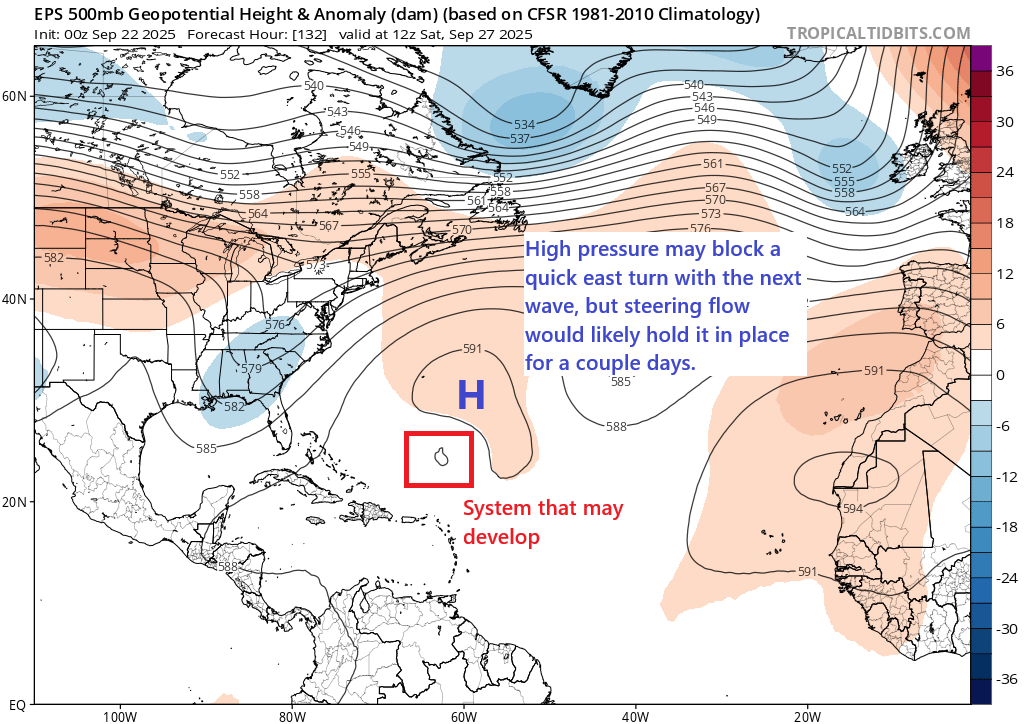
Over the next few days, this broader area may try to consolidate some, and we should see gradual development into a tropical depression or tropical storm. Invest 90L will track around the western edge of high pressure just west of the Azores, meaning it will continue on a north-northwest or northward trajectory. Model guidance at this point seems to suggest it will stay east of Bermuda on its way north, but we’ll continue to watch this, particularly once we (presumably) get some development out of this area.

Tropical model guidance has a relatively tight spread keeping 90L east of Bermuda, but it’s close. (Tropical Tidbits)

Interests in Bermuda should continue to monitor 90L over the next couple days. We do not expect this one to explode and rapidly intensify to a high-end storm like Erin did. But we could see it quickly come together as a tropical storm.

Invest 99L

Backing off to the south and east now, we look at Invest 99L. This one has had the opposite problem of 90L. Models have insisted it would eventually succumb to shear and dry air, and it’s been as resilient a wave as we’ve seen all season. Well, Invest 99L’s luck may be running out.

Invest 99L is looking much less organized and much uglier than it has all week. (Tropical Tidbits)

Over the next 3 to 4 days, Invest 99L will continue to have a puncher’s chance at perhaps sneaking into tropical depression status before likely getting ripped up again in the Caribbean. Interests in the islands should at least keep an eye on this, particularly for the Windward Islands. But this seems like mostly just a scattered heavy rainmaker right now. Beyond the islands, it seems likely that this will remain buried in the Caribbean or end up moving ashore in Central America eventually as a remnant disturbance. But we’ll continue to watch in case something should change.

Flooding risks

Yesterday saw a flash flood emergency, our first in quite some time, this one in Roanoke, Virginia. Read Kevin Myatt’s always excellent coverage in the Cardinal News for more on that event. But 3.38 inches of rain in an hour is more like Gulf Coast style than Appalachia. Very impressive stuff.

Flash flooding risk today will be mainly in Georgia and South Carolina back across the Gulf Coast, as a stationary front is draped across the region. But as we go into next week, we continue to see a pretty strong signal for heavy rain in the Plains. A slight risk (2/4) for excessive rainfall and flooding remains painted on the maps for Monday between the Front Range and Kansas & Oklahoma.

Slight risks for heavy rain (2/4) are in place on Monday from the Rockies to the Plains. (NOAA WPC)

Colorado Springs, Wichita, Tulsa, and Oklahoma City are all included here. For Tuesday, that risk shifts mostly back into Colorado and New Mexico. Rain totals over the next week continue to look quite healthy in these areas, with perhaps 1 to 4 inches in Colorado and parts of New Mexico and 3 to 6 inches in Kansas and Oklahoma.

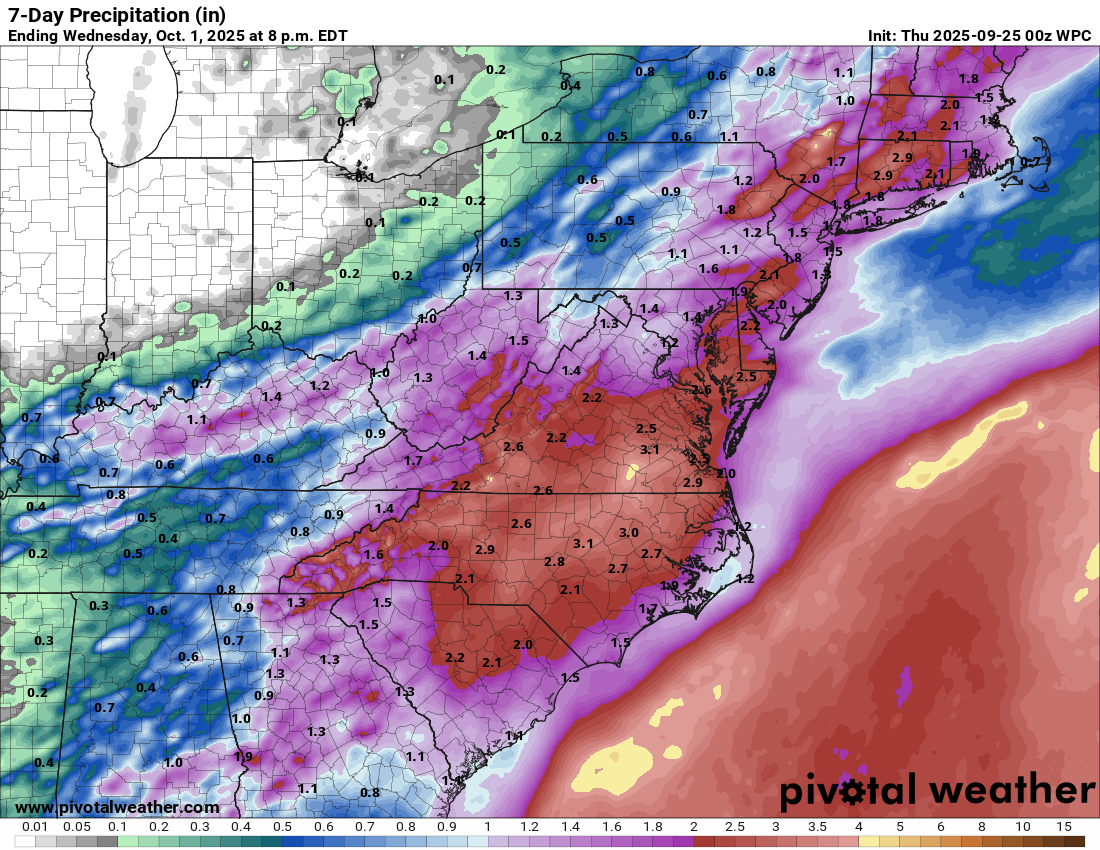
Rain totals over the next week are stout between the Rockies and Plains. (Pivotal Weather)

Considering the Rio Grande has dried up to a trickle or worse, any amount of rain that could find its way into the system would be beneficial.

Hurricane Erin lashing coastal North Carolina with tropical storm conditions

In brief: Hurricane Erin is passing by the Outer Banks today, and it will begin to accelerate out to sea. Coastal flooding will remain an issue into tomorrow for the East Coast, particularly from North Carolina into New Jersey. Mostly wave impacts for Atlantic Canada, but also perhaps some wildfire concerns there too. The rest of the tropics are noisy, but only one wave bears much watching (Bermuda). Also, the latest on upcoming heavy rains in the Plains.

Hurricane Erin

(NOAA/NHC)

Erin is making its closest approach to the U.S. this morning. The very large storm sits about 210 miles east of Cape Hatteras, and it has begun to turn to the north northeast. The tropical storm-force wind field of Erin extends out over 300 miles from the center. Despite the fact that the storm has weakened to about 105 mph this morning, the hurricane-force winds extend out 105 miles from the center. This is a massive storm.

Erin is large and in charge. (Tropical Tidbits)

A 2 to 4 foot surge on the ocean side of the Outer Banks will be ongoing, coupled with powerful waves. It is expected that this evening’s high tide cycle will be the highest though, with Duck, NC seeing a water level up to about 7 feet, less than a foot below the 2003 Isabel record there and the highest since a nor’easter in 2022.

Tidal forecast at Duck, NC. (NOAA NWS)

Flooding will be minor to moderate on the Pamlico Sound side of the Outer Banks, with downeast Carteret County seeing the worst this evening around 8:30 PM. High water levels are expected to continue into Friday, and it’s likely that some travel will become impossible through today and tonight in the Outer Banks, Ocracoke, and Carteret County.

Even farther up the coast, the tidal flooding will be significant. Cape May, NJ is expecting a peak water level of 8.2 feet this evening, which will be the highest since the “Snowzilla” nor’easter of January 2016. Same goes for Lewes, Delaware.

Tidal forecast at Cape May Harbor (NOAA NWS)

Erin will continue to exit tomorrow, and conditions up and down the East Coast will slowly improve. For Atlantic Canada, the main impact will be rough surf, particularly in Newfoundland and perhaps Nova Scotia, where breaking wave heights could be 3 to 5 meters high. Erin should transition to an extratropical storm by Saturday.

Wildfire concerns?

A minor note, but perhaps a notable one, there will be somewhat enhanced wildfire risk in Atlantic Canada as Erin passes. Note the fire weather danger outlook for today is pretty high to extreme in parts of Newfoundland and even Nova Scotia and New Brunswick.

High to extreme fire weather danger in Atlantic Canada today. (Natural Resources Canada)

Portions of Atlantic Canada remain in severe to extreme drought conditions, so the combination of drier air being wrapped in from the north and gusty winds as the large swath of Erin passes by definitely can enhance fire danger. This is an element of storms that’s now on a lot of people’s minds in the wake of the tragedy in Maui a couple years ago, as a passing hurricane likely contributed some to drier, windier conditions there. Something for folks in Atlantic Canada to be mindful of over the next 2 to 3 days.

Rest of the tropics

The Atlantic is a multi-colored menagerie of disturbances this morning. We have Invest 99L in the central Atlantic, the tropical disturbance approaching the Caribbean islands that we’ve been discussing for a few days now, and a little fella in the open Atlantic.

It’s a party in the Atlantic! (NOAA NHC)

Let’s start from best odds of development to least odds.

The wave approaching the islands with a 70 percent chance of development is looking ragged but stormy today. There’s no sign that this is going to develop quickly, but it’s starting from a pretty decent baseline.

A tropical disturbance approaching the Leeward Islands will bring thunderstorms and locally heavy rain to the northeast islands this weekend. (Weathernerds.org)

This one is expected to pass northeast of the islands, much like Erin did, so the only impacts will probably be some scattered thunderstorms this weekend. It’s hot in Puerto Rico and the Virgin Islands right now, and heat advisories are posted with hot, dry weather and Saharan dust causing hazy conditions. That will change as this passes. From there, it will probably turn straight north toward Bermuda. It seems as though it will turn out to sea before arriving in Bermuda, but interests on that island should continue to monitor this system in the coming days. As you can see below, most European ensemble members miss Bermuda to the east, but it is at least notable that some of the stronger outcomes get a little closer to Bermuda itself. Again, something to monitor at least.

The disturbance near the islands should miss Bermuda to the east, but there are a couple of solutions that are possible that bring it closer to the island. (Weathernerds.org)

We’ll keep tabs on this one.

To the east, Invest 99L continues to percolate west of the Cabo Verde Islands. This wave has looked excellent since emerging off Africa, but it has yet to do anything to get it over the hump yet to become a tropical depression.

Invest 99L looks beefy again this morning, as does the wave behind it, but conditions are expected to degrade for development in the Atlantic in a day or two. (Weathernerds.org)

As 99L comes due west, it’s likely to run into a wall of wind shear. That should kill any chances of organization. The remnant disturbance should continue west toward the southern Caribbean. Typically, it’s a good idea to maintain some degree of vigilance with systems like this, as their ghosts can sometimes be resuscitated once in the western Caribbean. The bulk of what remains of this disturbance may actually end up close to South America, which would essentially wipe out odds of development, even in the western Caribbean. Still, it makes sense to keep tabs on this one in about a week or so, just to ensure it doesn’t pull a fast one on us.

The wave behind 99L is not expected to develop and should remain out at sea.

Meanwhile, the NHC tagged a little one this morning. That one near 30N/50W is kind of comedic looking this morning when viewed next to Erin.

I am reminded of “Aladdin” with this. (Weathernerds.org)

That’s about it. As Eric noted yesterday, after these systems, we don’t exactly have anything noteworthy to home in on. Yesterday’s Euro weeklies suggest below average odds of tropical cyclone development in most of the basin for the week of Aug 24-Sept 1.

Below normal odds of development next week in the tropical Atlantic. (ECMWF)

Notably, these odds turn neutral to perhaps even above normal by mid-September. So the first part of September may be calmer than usual, but we’re clearly not done with hurricane season yet. But this is good news in the nearer-term.

Heavy rain coming to the Plains?

After a somewhat calmer period of weather in the Southern Plains, we may see a return to more active, wetter weather heading toward next week. The WPC has already issued a slight risk (2/4) for excessive rainfall for next Monday.

Flash flooding will return to the forecast potentially by early next week. (NOAA NWS WPC)

Rain totals are currently forecast to be on the order of 2 to 4 inches over the next 7 days, and there could be some locally higher amounts in parts of Kansas, Oklahoma, or Colorado.

Rain forecast for the next week in the southern Plains. (Pivotal Weather)

We’ll keep an eye on this as well.

Erin restrengthens as it moves north, and we look at the what’s left in its wake (not much, probably)

In brief: Hurricane Erin is getting stronger again, and it may reach major hurricane status as it passes by the Carolinas and brings impactful storm surge to the Outer Banks. We also take a look at what is coming next in the Atlantic, and we are cautiously optimistic about things heading into September.

Hurricane Erin status

As of 11 am ET this morning, Hurricane Erin has continued to regain some of its former strength. The system now has sustained winds of 110 mph and a central pressure of 941 mb. Additionally, its eye has a better appearance on satellite which is another indication of better organization. The storm has about a day, or a day and a half to intensify further before wind shear should start to work on it. Confidence remains high in the track forecast, with Erin set to split the difference between the US mainland and Bermuda before moving out to sea later this week.

Storm surge along the Carolinas will build over the next day, with inundations of 2 to 4 feet above normally dry ground expected. This surge should be most impactful for the low-lying Outer Banks area, leading to numerous roads becoming impassable. Additional concerns include significant beach erosion, and sand being washed onto roads. Tropical Storm Warnings are in effect for coastal areas of North Carolina and Virginia.

A Tropical Storm Watch is also in effect for the island of Bermuda, where there could be high winds and dangerous surf and rip currents.

All that being said, we’ve largely been fortunate with Erin, being that it was such a powerful storm that got close to many landmasses but never directly threatened a landfall. We’ll be glad to put this system in the books over the next couple of days.

What’s next?

With the forecast for Hurricane Erin well in hand, it’s time to look ahead to what is coming next in the Atlantic season. Now that we’ve had the season’s first hurricane (and major, and Category 5 storm) it seems clear that the Atlantic tropics are open for business. We are now firmly in the most frenetic time of the year for Atlantic activity, the period from mid-August through mid-October.

But for the rest of August, at least, the tropics look pretty tame. I don’t want to manifest anything and I am certainly not tempting Mother Nature, but I like the setup for the rest of the month. Moreover, when we peek ahead at conditions for early September, there just is not too much evidence that things are going to start sizzling any time soon. For example, here’s the latest sub-seasonal forecast from the ECMWF model for the first week of September. As you can see, it is predicting just 40 percent of normal activity in the Atlantic basin. Of course such models are far from perfect, but you would rather see such forecasts than the alternative.

European model forecast for “accumulated cyclone energy” from Sept. 1 to September 7. (ECMWF)

With that said, let’s take a look at what we’ve got going out there.

Central Atlantic disturbance

This tropical wave continues to propagate westward, and is edging closer to the Caribbean Sea. As of this morning, the National Hurricane Center gives the system a 60 percent chance of becoming a tropical storm or depression over the next week.

National Hurricane Center tropical outlook.

There are a variety of solutions for this system, which is natural since there is no clearly (or even poorly) defined center of circulation this morning. This makes it more difficult for models to latch onto a center and project it forward. Generally, however, most of our model solutions bring the storm northwestward, likely missing a majority, if not all of the Caribbean Islands. The image below shows the cluster of outcomes from the European model ensemble, and as you can see this is probably a fish storm.

The other thing to note is that if the storm does come closer to the Caribbean islands, including Puerto Rico, it likely is to be weaker (perhaps not even a depression) than if it recurves northward more quickly. The bottom line is that the upper-end intensity of this storm does not look all that high, and if it does get strong it’s probably going to miss land entirely. So we’ll watch it, but not with too much concern.

Invest 99L

The system behind that one actually got tagged as an “area of investigation,” but I’m not overly enthused about its prospects either. We can probably expect this wave to meander westward across the Atlantic and it may eventually move into the Caribbean Sea. As Matt noted yesterday these waves can be tricky, because they spend days doing nothing and then find a favorable patch of atmosphere and organize quickly. But for now there is virtually nothing, zilch, and nada in our models to indicate this will happen with 99L. So we’ll keep an eye on it, partly because beyond this there’s not much else expected to happen over the next 10 days.

Model data is essentially worthless at this point, but I think these tracks are illustrative of what we can expect with 99L. (NCAR)

Which is a great place to be in late August.

Erin on track to impact the U.S. East Coast with waves and erosion while we size up the disturbances behind it in the Atlantic

In brief: Hurricane Erin is fighting off some dry air and shear this morning, which has caused it to lose intensity but maintain a large size. Forecast impacts to the U.S. East Coast are virtually unchanged today. Two tropical features in the Atlantic behind Erin are worth keeping tabs on, but none looks to be a serious land threat at this time.

Hurricane Erin

(NOAA/NHC)

Erin has finally hit a bit of a wall since last night in terms of intensity. Maximum sustained winds have dropped to 110 mph. Where Erin has not hit a wall is its size, which remains quite large. For the U.S. East Coast and Outer Banks in particular, this means little has changed since yesterday.

Erin continues to brush the Bahamas and hit the Turks and Caicos with persistent bands of thunderstorms, despite its disheveled appearance this morning. (Tropical Tidbits)

We’ll get the easy part out of the way quickly this morning. Erin’s track forecast remains pretty solid with very little model spread over the next 3 to 4 days as it turns north and eventually northeast. Track forecast confidence is probably a bit higher than usual at 4 days of lead time. There’s a little more spread in the guidance once it gets south of Newfoundland, but all modeling currently keeps it well offshore.

Erin’s intensity forecast is a little trickier. Given the look this morning, with dry air wrapping into the storm and exposing the core, I have to think that Erin is embarking on a long road down. We could see some reintensification once Erin starts to pick up a little more speed. But I think the question is how much weaker it gets in the near term. Erin isn’t in a hurry right now, and it may be churning up relatively cooler water underneath the ocean. Between that and dry air, it’s just flat at this time. Whatever the case, Erin is likely to remain somewhat flat today, with some chance of reintensifying tomorrow and Thursday as it marches north. Erin will then slowly transition into a non-tropical (extratropical) storm by late in the weekend and it begins to accelerate out to sea.

Erin’s impacts remain mostly unchanged. We’ve now got Storm Surge Watches and Tropical Storm Watches on the North Carolina Coast.

(NWS Morehead City)

Wind gusts of 50 mph will be possible on the Outer Banks and in Pamlico Sound. The wave action and higher tides will be what causes extensive damage, likely damaging vulnerable coastal buildings and perhaps even Highway 12. While the surge forecast itself is not eye-popping (2 to 4 feet), in this area, when combined with the waves, that’s more than enough to cause damage. North winds will peak Soundside flooding on Thursday.

(NWS Morehead City)

As we’ve been hammering since the weekend, in addition to the storm impacts on the Outer Banks, waves, tidal flooding, and rip currents are going to impact much of the Eastern Seaboard, causing beach erosion and making swimming challenging, if not dangerous the next several days.

Rip current risk is high the next two days from about West Palm Beach through Block Island. This will continue farther north Thursday and Friday. (NOAA NHC)

Rip currents kill over 100 people each year. These are avoidable deaths. Please heed all flags and warnings this week.

Wave trailing Erin + Invest 99L

Looking at satellite this morning, it’s kind of interesting that the wave we’ve been monitoring for the last few days looks far less impressive than the new one behind it. In fact, that wave near the Cabo Verde Islands is termed Invest 99L. For those curious, now that we’re at Invest 99L, we will recycle the list of Invests. So whenever the next system comes around, it will be tagged 90L. It’s entirely possible that the wave ahead of 99L gets tagged 90L at some point. Whatever the case, here they are.

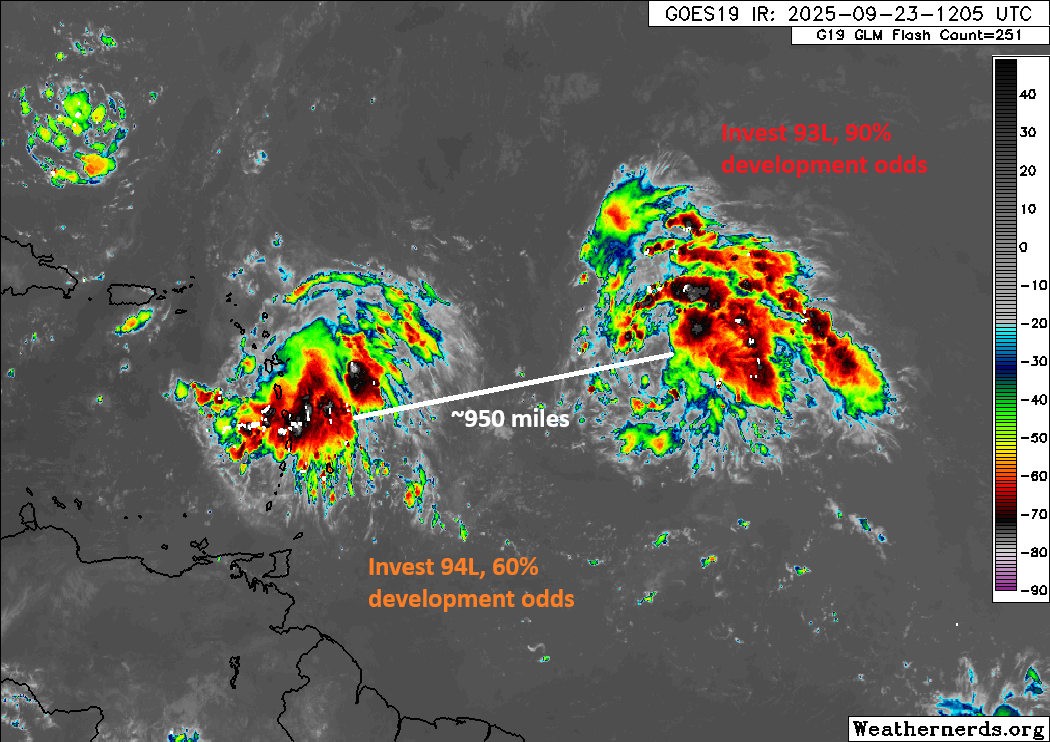
The wave west of the Cabo Verde Islands is mostly unchanged today and has 60% development odds, while the wave closer to Africa looks very impressive. (Weathernerds.org)

Over the next 2 to 3 days, it is expected that Invest 99L will actually weaken, while the wave in front of it will actually strengthen. As the leading wave strengthens while moving west, it will probably begin to get drawn into the weakness in upper-level ridging left behind by Erin. You can see that by looking at the upper-level weather map on Thursday evening. The leading wave is approaching the islands. Between Erin’s proximity to the north and the weakness in upper ridging left behind, this wave should turn northwest near the islands.

The upper pattern late Thursday shows the next tropical wave (not Invest 99L) in position to turn more northwesterly, following Erin just to the east. (Tropical Tidbits)

Both AI modeling and the Euro ensemble members today favor a sharper turn north, which would draw it on a track east of where Erin is going. I would say this is worth keeping an eye on for the islands and for Bermuda at this point. A long way to go still with this one.

So what about Invest 99L? Well, I’m always leery about waves like this one. As noted above, it should begin to fall apart in a day or two, so any development risk is short-lived in the near-term. But because it falls apart and stays relatively weak or undeveloped, it’s likely to sneak under everything going on to its north and west. This means it will probably ultimately find the Caribbean. From there, it’s anyone’s guess, but interestingly, virtually all modeling (except the GFS operational of course) basically keeps the wave a suppressed, weak feature into Central America. Either way, it’s at least 10 days from probably doing anything, so we have plenty of time to watch and it’s nothing anyone needs to worry about right now.