All the action lives in the Pacific, while locally heavy rain impacts the Southern U.S.

In brief: While the Atlantic looks mostly quiet, some low-end development is possible next week. The Pacific looks active, and we’ll see how any remnant moisture from developments maneuvers into the Southwest. Meanwhile, the region between New Mexico and Mississippi will be at risk for flooding today and this weekend.

Tropical Atlantic embracing a slow go

Fernand is now post-tropical and exiting. We appreciate its service.

See ya. (NOAA/NHC)

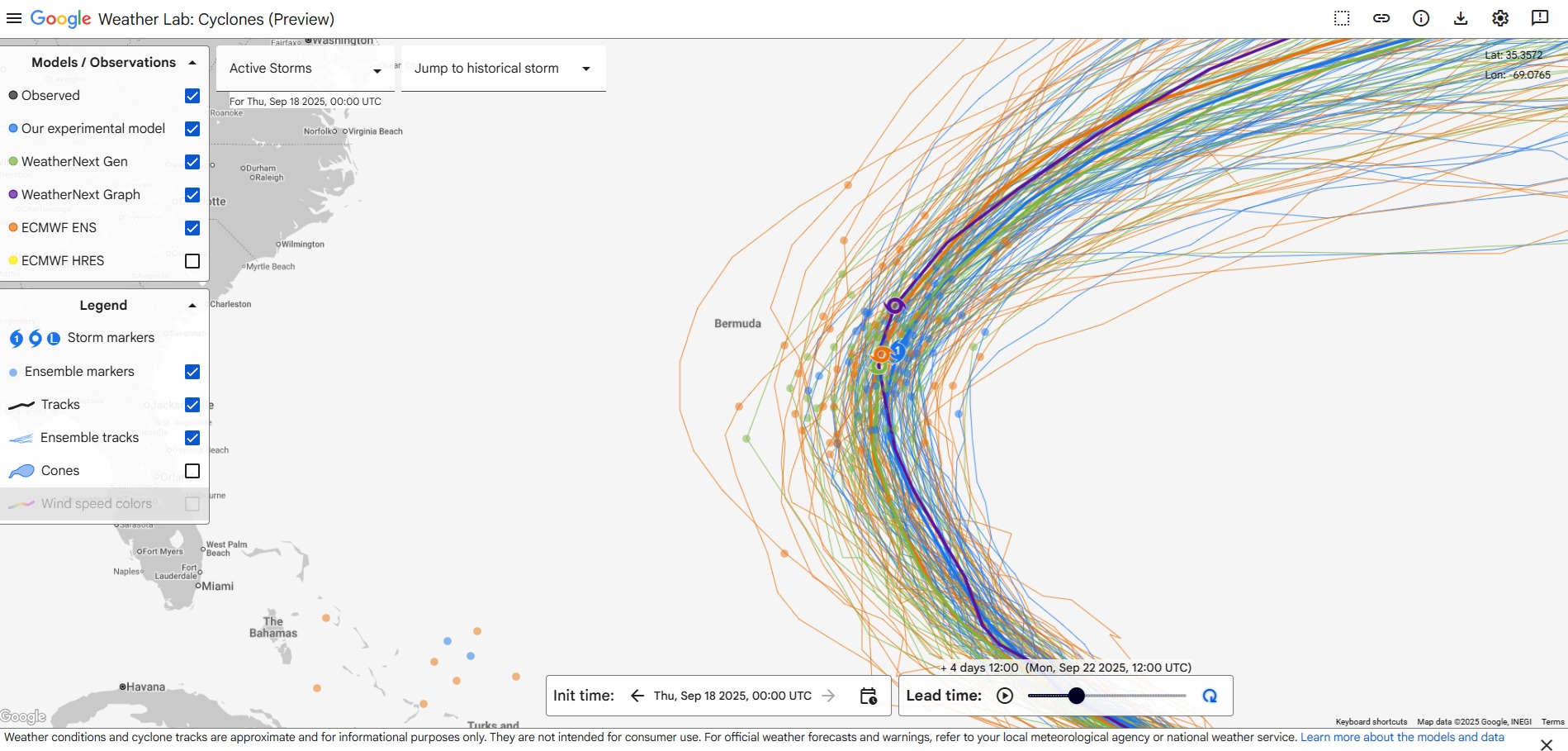
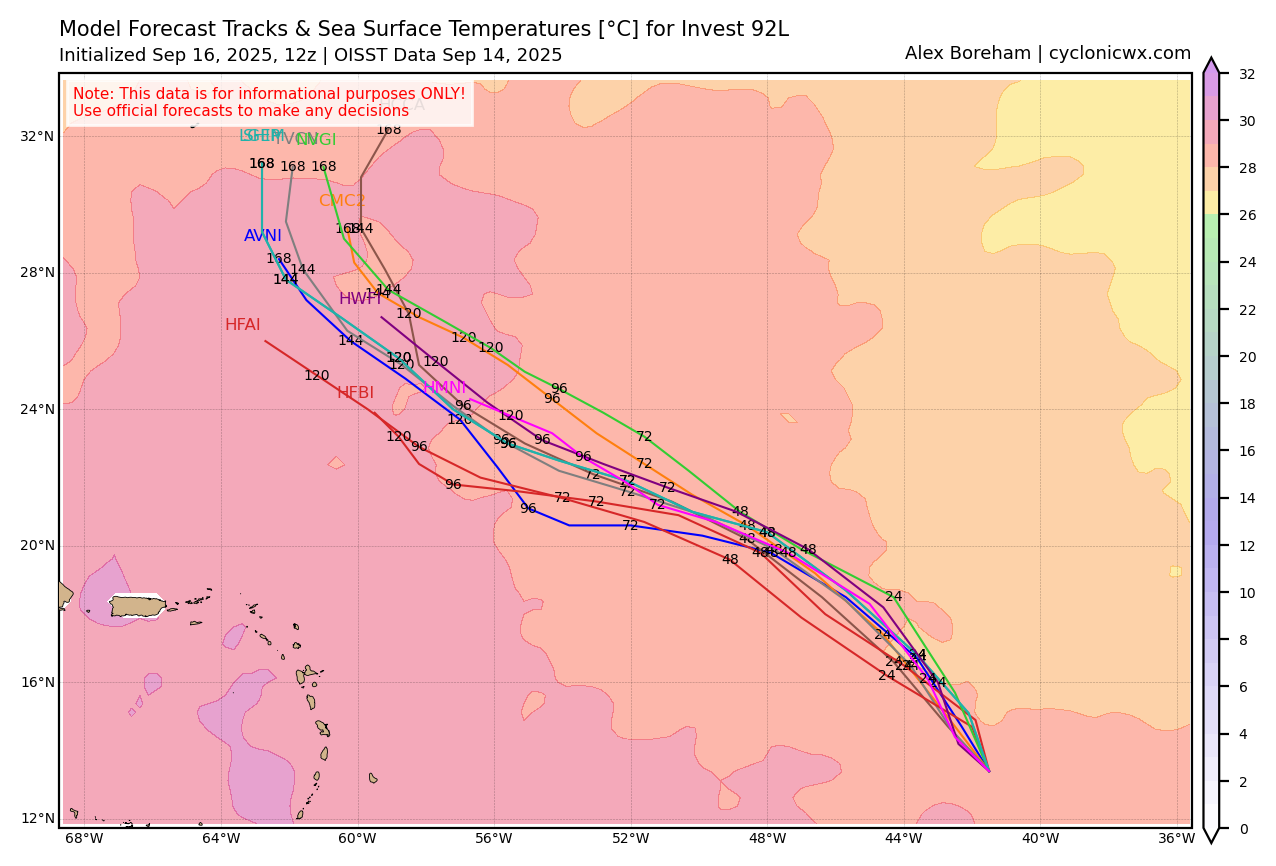
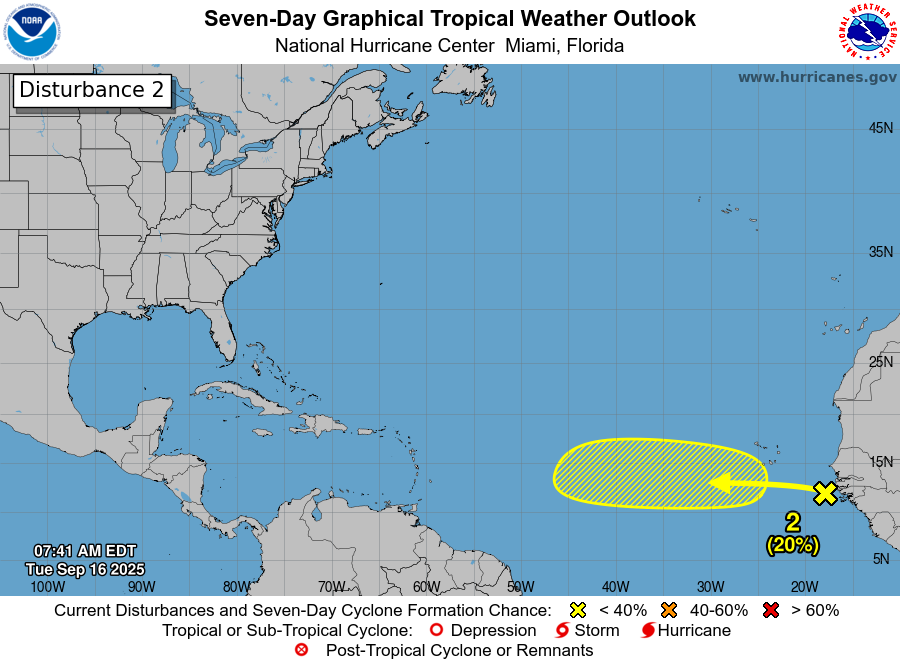
Meanwhile, the National Hurricane Center tagged a new area today off the coast of Africa. This is the tropical wave we discussed a bit yesterday that seems to have some model support for development. It’s expected to emerge off Africa this weekend, and slow development could allow it to become a tropical entity sometime later next week. Modeling remains modestly supportive of this. By no means is this a slam dunk development case. But enough European ensemble members and AI ensemble members and operational modeling shows this somewhere in the central Atlantic and at least trying to develop next week.

Modest agreement between and among various traditional and AI ensembles that development is possible next week in the Central Atlantic. (Google Weather Lab)

Where it goes from here is hard to say, but a general west-northwest track seems likely at this point. One thing models seem to agree on strongly for now is that this system may have a very low ceiling. In other words, there’s a slight chance it develops, but there’s a higher than usual chance that if it does develop, it would not be a particularly large or strong storm. We’ll keep tabs on it of course, but for now this is not something we feel anyone needs to worry much about.

An additional wave or two may follow off Africa next week, but none of them look particularly menacing at this time.

Terrific Pacific

Meanwhile, there aren’t any imminent land threats on the Pacific side of the tropics, but that’s where the action is.

Juliette is now a post-tropical cyclone that may deliver some rain to the Southwest. Two other areas could develop over the next week. (NOAA/NHC)

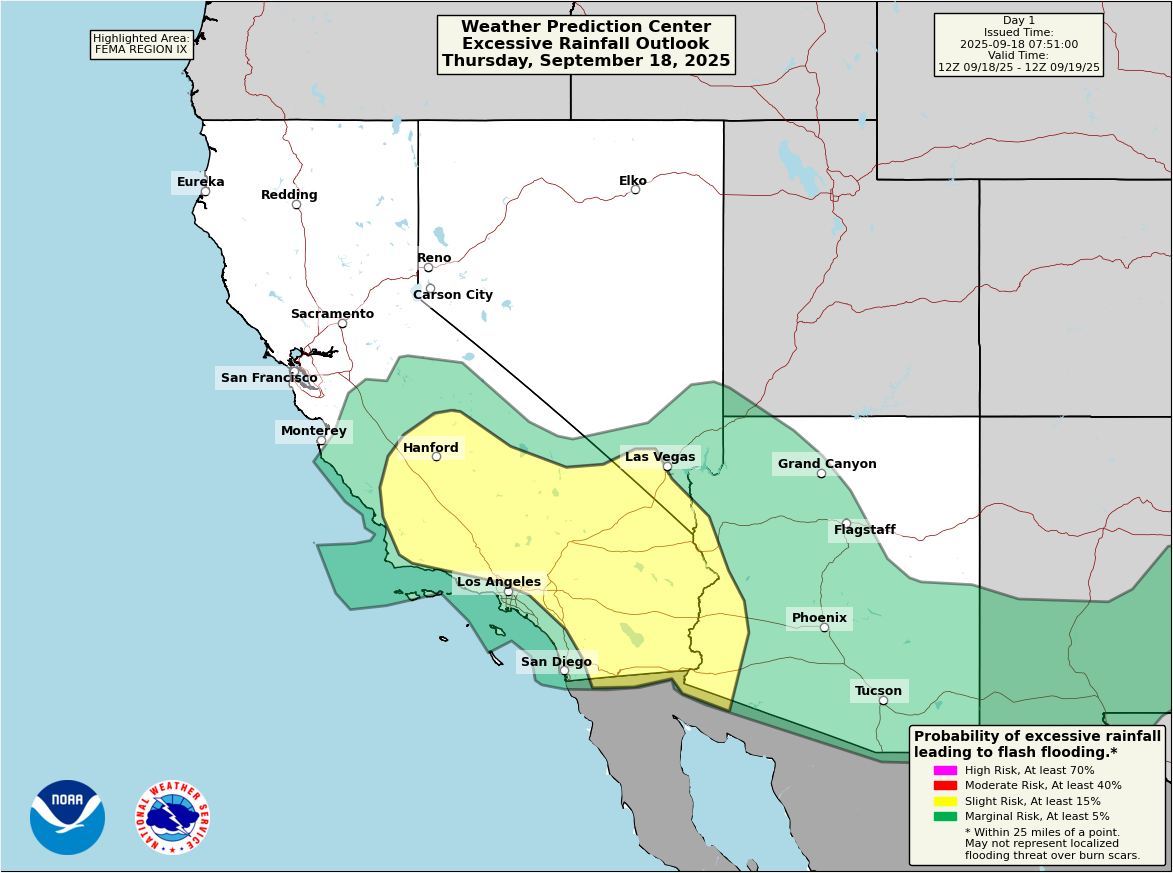
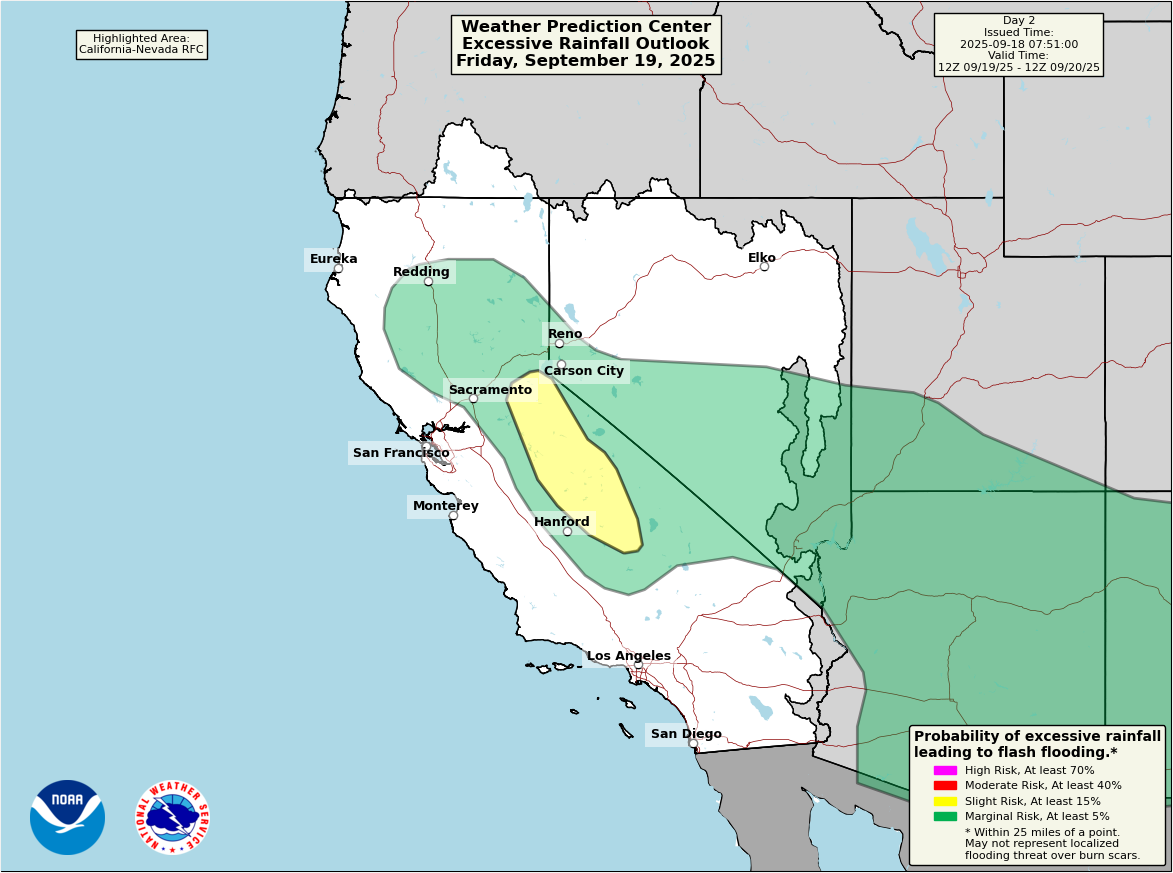
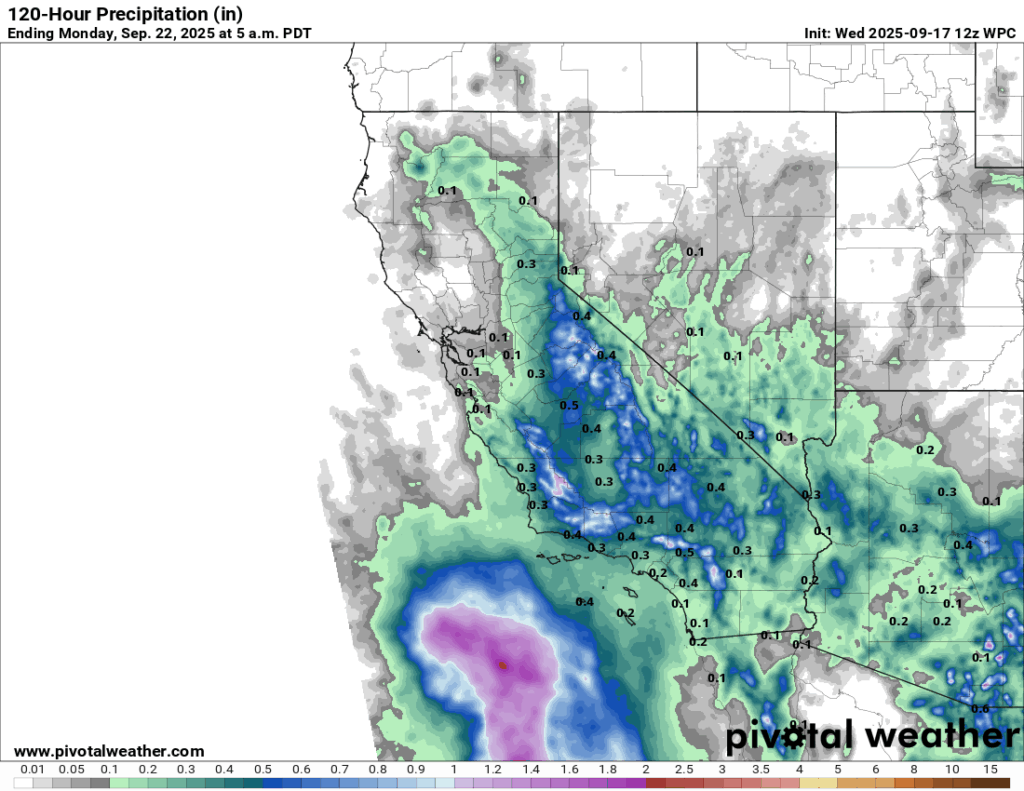
Juliette will be responsible for rain showers in the Southwest today as some of its remnant moisture arrives. Rain totals won’t be high, but any moisture is welcome in the desert.

Anywhere from a tenth to quarter-inch of rain may occur today in parts of Southern California, including San Diego.

Beyond Juliette, there is both a medium and high-risk area to watch for development in the Eastern Pacific. Neither of those look to threaten land ultimately, but we may get some interesting satellite imagery or even another Juliette-type situation where remnant moisture finds the deserts of northwest Mexico and the Southwest U.S.

Wet Southern Tier

We’ve already got heavy rain happening in southeast Kansas and northeast Oklahoma this morning, where some flooding risk will live today. That heavier rainfall will cruise southeast across Arkansas and into extreme northeast Texas and Louisiana today.

A slight risk for flash flooding (2/4) exists from near Tulsa south into northern Louisiana today as heavy thunderstorms migrate southward along a frontal boundary. (NOAA WPC)

Rain totals of 1 to 3 inches with isolated pockets of 4 to 5 inches are possible along the trajectory of the storms through the slight risk area highlighted above today and tonight.

Over the next couple days, the flooding risk will maneuver around the South, tomorrow including Mississippi and Louisiana again but also West Texas and New Mexico. Heavy rain chances will linger at times in Texas and New Mexico from Sunday into early next week. In fact, a widespread 1 to 3 inches seems possible when all is said and done. There will almost certainly be higher amounts in spots. Burn scars in New Mexico (including Ruidoso) will probably be at higher risk of flash flooding.

Widespread, mostly beneficial rain will fall in West Texas and southeast New Mexico through the holiday weekend. (Pivotal Weather)

We will probably see flash flood watches in spots over the next day or two for that rain.

Checking on what’s next in the Atlantic, as monsoon moisture flexes in the Northwest

In brief: The tropics will be quiet over the next 5 days or so before perhaps our next wave worth watching next week. Meanwhile. flooding risk perks up today in the Northwest, with Idaho in focus for locally heavy rainfall.

Tropics

Tropical Storm Fernand continues on its merry way.

(NOAA/NHC)

Maximum sustained winds are 45 mph, and while it looks better than it did 24 hour ago, it’s still not in great shape. Expect to see Fernand go post-tropical by the end of today.

Fernand floating away. (Weathernerds.org)

Behind Fernand, the Atlantic is quiet as a church mouse. While the next tropical wave to emerge off Africa looks kind of robust, it is going to likely fall apart once in the Atlantic.

The tropical wave about to emerge off Africa looks healthy, but it’s expected to falter once offshore. The lesser wave behind it exiting Nigeria may have better odds next week. (NOAA)

The wave that’s moving west out of Nigeria seems to be one that is getting some attention on the weather models. The AI models in particular seem to like this one’s odds of developing sometime next week. Any development would probably be sluggish due to a still generally hostile background state in the Atlantic. Again, the hostile background doesn’t mean things cannot develop; it means they’ll probably struggle somewhat, however.

Some European ensemble members, as well as several Google AI ensemble members suggest the wave emerging off Africa in several days may have some development odds next week. (Google)

Aside from that, we don’t note any specific threats in the tropics over the next week or two. We’ll keep watching.

Elsewhere: Monsoonal flex in the Northwest

Today’s weather story will probably be in the West where abundant monsoon moisture will be in play in the Great Basin and Intermountain Region.

Locally heavy rain and flash flooding is possible across southern Idaho, eastern Oregon, and points south today. (NOAA WPC)

The focus of the heaviest rain may be on the Bitterroots and southern Idaho. Flood Watches extend from that area south into the Great Basin and northern Nevada. There’s a strong signal for 1 to 2 inches or locally higher amounts of rain in spots today, particularly in the Bitterroots. North-Central Idaho will also be in play for some of the heavier rain risk today.

Some locally heavy rain is likely across Idaho into the Bitterroot Mountains today, with isolated heavier rain south of here. (Pivotal Weather)

The heavier rain risk focuses back into Oklahoma and Arkansas tomorrow.

Fernand’s finale, Erin’s warm Europe, an AI modeling W, and a major Phoenix haboob

In brief: Fernand will soon become post-tropical as it heads out to sea. Warm weather in Europe thanks in part to Erin’s remnants will soon end. Today, we also discuss how AI modeling fared during Hurricane Erin, as well as a massive haboob that descended on Phoenix, Arizona yesterday.

Tropics: Fernand, and Erin’s remnants in Europe

We are starting off Tuesday with essentially a clean slate. There are no current areas of interest with respect to the tropics. The only item out there is Tropical Storm Fernand. The storm should become post-tropical by later today or tomorrow as it scoots out to sea.

Fernand is gone to the fishes. (NOAA NHC)

In fact, Fernand is kind of cool to look at on satellite imagery this morning. It’s become almost a “naked swirl,” as virtually all deep thunderstorm activity around the storm has vanished or been left behind due to wind shear.

Fernand is approaching “naked swirl” status. (Tropical Tidbits)

Fernand will be funneled off toward Europe where it should be absorbed into the larger storm system that also contains the remnants of Hurricane Erin. Temperatures are running about 6 to 10 degrees above normal in western Europe with that storm system sitting just south of Iceland. The circulation around it pumps very mild air into Europe, particularly western Europe, and London has ended up with low 80s instead of low 70s for highs.

Tuesday afternoon temperature anomalies in Europe shows most of western Europe warmer than usual. (Tropical Tidbits)

Somewhat cooler weather and some breezy unsettled weather is on the way to Europe as this storm system dislodges. Anyway, the point of a longer note than usual this morning is to show how even “fish” storms can provide interesting things to discuss.

There are no other tropical concerns today.

A feather in the cap for AI weather modeling

Speaking of Hurricane Erin, let’s talk briefly about verification. When it comes to writing our daily updates here, we are vehemently anti-AI. You’re always going to hear from a human when you read The Eyewall. However, when it comes to weather modeling, AI (or really, machine learning) is adding new, extremely valuable tools to the arsenal we have to forecast with.

Some of the initial results are in from Hurricane Erin’s forecast, and Google’s Deep Mind AI model scored a pretty significant win for these new tools. Between hours 12 and 72 of the forecast, the GDMI on the plot below (shared by former NHC Branch Chief James Franklin) outperformed the best tropical models and even the NHC. Notably the NHC also outperformed the models in that timeframe as well, a win for them.

Model track error during Hurricane Erin for various weather models. (James Franklin on BlueSky)

After hour 72, the picture becomes a little blurrier for AI with the HAFS-B (HFBI) taking control. TVCN represents a consensus aid, and the GDMI from Google beat it all hours. I was more impressed to see how it handled intensity, truthfully, as AI modeling has tended to struggle a bit in that department.

Google’s Deep Mind model (GDMI) outperformed most guidance through hour 96 of the forecast for intensity. (James Franklin on BlueSky)

Again, Google’s Deep Mind outperformed virtually all traditional model guidance through 72 hours. Even later in the forecast horizon, it ended up in the top third of guidance.

So what can we really say here?

First off, let’s just call it what it is: Certain AI modeling, which require far less computational resources and take extraordinarily less time to run is able to perform essentially as good or better than traditional modeling when averaged over the life cycle of a major hurricane. That last part is important. It’s just one storm, yes, but this is something we have anecdotally noted since last year. AI modeling tends to be much more stable with respect to storm track, particularly in the first 3 days of the forecast, which is certainly important.

However, averages are just averages, and while the AI modeling performed outstandingly over the lifespan of Erin, there’s a difference between storm-life statistical average and operational effectiveness in real-time. Also, Erin’s forecast track frankly didn’t have a ton of major uncertainty in the 5-day time horizon. There were questions of exact turn timing and location, but short of that, it became more a matter of semantics than anything. The intensity forecast was really well done by AI modeling all things considered.

So it’s important to contextualize this. Google’s Deep Mind represents one AI model. Hurricane Erin was one storm. But AI modeling has proven time and again that it can hang with the best modeling, particularly with respect to track but also now in some cases intensity too. It’s also important to note that the National Hurricane Center outperformed most model guidance on track and intensity. The assumption here is that given the technical expertise that resides in the NHC, as these AI models become more proficient and get validated, those will be further incorporated into the NHC forecast process. And the NHC should continue to shine overall.

Haboob in Phoenix

Shifting gears now, the Phoenix metro was overtaken by a massive haboob yesterday. What’s that? It’s a massive dust storm usually kicked up by the winds of strong thunderstorms moving over the desert or dried soil. And indeed, yesterday’s haboob in Phoenix was something else.

You can read more about the history and etymology of the term haboob here, but while these are somewhat common in the Southwest, one of this magnitude overtaking a major metropolitan area is pretty incredible to watch. The good news is that it wasn’t just all dust. Much of the Valley of the Sun and beyond saw some good rains as well yesterday.

A sampling of 24-hour rain totals ending this morning across the Phoenix region. (NOAA)

A continued chance of isolated to scattered monsoon thunderstorms will be with parts of Arizona at least from today through Thursday.

Fernand exiting, 99L dissipating, and the Atlantic quieting down

In brief: The Atlantic tropics are going to trend quieter, with Fernand heading out to sea and Invest 99L finally reaching the end of the road. Behind those? Not much. A significant typhoon hit Vietnam today. Flooding risks will continue in Oklahoma and Arkansas this week.

Tropics

We don’t have a heck of a lot to discuss today in the Atlantic! Tropical Storm Fernand continues to slowly work out to sea and away from Bermuda.

Fernand heads out to sea and should be absorbed into the broader weather pattern by later tomorrow or Wednesday. (NOAA NHC)

Fernand has strengthened a little since our post yesterday, as expected. However, it’s not exactly healthy. The center seems somewhat displaced to the north side of the thunderstorms, and it’s pretty evident that wind shear is beginning to really hamper Fernand.

Fernand is fighting wind shear and will soon have to fight cooler water too. (Tropical Tidbits)

Meanwhile, to the south, Invest 99L has finally met its fate it would seem. Where did all the thunderstorms go?

(Weathernerds.org)

Thankfully, it just took some time but it got here. Look for the remnants of 99L to spread west across the Caribbean, bringing some scattered heavy rain and storms before eventually being buried in Central America or even South America as a small-scale feature. No development is expected, and this should probably close the book on this version of Invest 99L.

Beyond these areas, we see nothing of note in the Atlantic tropics for the next week, probably longer. A very rare and welcome late August and early September break seems to be in the offing this year. We will absolutely take that.

Typhoon Kajiki around the time it made landfall in Vietnam. (Tropical Tidbits)

In the Pacific, Typhoon Kajiki made landfall in north-central Vietnam this morning (U.S. time) as the equivalent of about a category 2 hurricane. Around 600,000 people were ordered to evacuate ahead of this storm.

Arkansas and Oklahoma flooding risks

Rain across the Plains will go on as expected, with heavy rain in parts of Oklahoma in particular.

Heavy rainfall across eastern Oklahoma and NW Arkansas today and tonight. (NWS Tulsa)

A second round of heavy rain is likely heading into later week as well. This round will be either Wednesday night, Thursday, and Thursday night.

More rain later this week. (NWS Tulsa)

More details in our post yesterday. We’ll keep it there for now. More on Tuesday!