Melissa to torment portions of the Caribbean, especially parts of Jamaica, with days of heavy rain and potentially catastrophic flooding concerns

In brief: Just a quick update on Melissa this morning. A more comprehensive update will be posted this evening.

Melissa remains disorganized this morning, with max winds of 50 mph.

Melissa continues to struggle a bit, though continues to have deep thunderstorm activity. (Weathernerds.org)

There have been minimal track or intensity forecast changes since yesterday.

Melissa’s track brings it a little closer to Jamaica than yesterday’s forecasts. (NOAA/NHC)

The biggest change is perhaps tracking it a little closer to Jamaica by next week. Tropical Storm Warnings are now posted for Jamaica, with Hurricane Watches for both Jamaica and southwest Haiti. A major hurricane is expected by late this weekend.

The rainfall forecast for Melissa remains ominous, with 12 inches (300mm) or more possible through the weekend in Jamaica.

Melissa’s rainfall forecast through Sunday morning. Additional high-end rains will follow this. (NOAA WPC)

When you factor in that this rainfall forecast is through Sunday morning, and there will be at least a couple more days of torrential rain to follow, portions of Jamaica could be in line for 20 to 30 inches (500-750mm) of rainfall before all is said and done. It’s an extremely concerning situation, particularly given that tropical storm, if not hurricane conditions may accompany those rains much of the time. We urge the strongest precautions for folks in Jamaica with respect to flooding in particular, but also for tropical storm and hurricane conditions.

We’ll be back later today with more color on this.

Melissa’s steadiness foretells a rather lengthy stay in the Caribbean, increasing the odds of explosive intensification later this weekend

In brief: Melissa’s intensity has held today, increasing the odds that it will remain in the Caribbean through the weekend, eventually finding a more hospitable environment for rapid, possibly explosive intensification this weekend. Significant impacts are likely for parts of the central Caribbean, particularly Jamaica, and Melissa may stick around well into next week. Eventually the storm will be picked up and carried northward into the Atlantic, but probably not before becoming a powerful, destructive storm in parts of the central or western Caribbean.

Tropical Storm Melissa is continuing to absolutely crawl west at a whopping 1 mph this evening. Melissa has not gained any strength today, and that’s not shocking. One of the problems with Melissa is that its general lower-end intensity early on is causing it to miss one exit ramp that it could otherwise take that would perhaps spare some of the central Caribbean a truly bad storm.

Melissa is expected to very slowly organize in the coming days before perhaps explosively intensifying after Saturday. (Polarwx.com)

In the meantime, with some 20 to 30 kts of shear buffeting the storm, it’s going to remain loosely organized. Reconnaissance aircraft are investigating the storm this evening, so we’ll see what they find.

Forecast-wise, not much has changed since this morning. The requisite tropical storm and hurricane watches remain posted. Melissa’s future track depends heavily on its structure. If the storm remains fairly disorganized, as expected by AI modeling and the European model, we will continue to see this drift northwest or west-northwest. If it can suddenly pull itself together, it will quickly feel the westerlies to the north that will pick it up and grab it and lift it out of the Caribbean and into the open Atlantic. The GFS model tends to favor this. Given the current disorganization, odds seem to favor the weaker, more time over warm water scenarios, eventually putting Melissa in extraordinarily warm waters with lower wind shear.

(Via Google Weather Lab)

Once it gets there, the sky is the limit. As we noted earlier today, extreme levels of oceanic heat content will be around to fuel Melissa for a longer time than a typical slow-moving storm. This likely means that we’re looking at a high-end major hurricane eventually by late this weekend or early next week. Its proximity to land will determine just how bad the impacts get, specifically for places like Jamaica, eastern Cuba, Haiti, or even Central America. But suffice to say, it looks ominous right now.

It will take a very strong upper level trough exiting the U.S. to pick up Melissa and pull it out of the Caribbean next week.

Melissa exits the Caribbean next week, probably after Tuesday. (Tropical Tidbits)

Theoretically, this should be a straightforward exercise: Trough digs into the East, captures Melissa on its way off the coast, and the storm exits. There’s still a fair bit of uncertainty on that last point, and we’ll want to watch how that trough progresses in the days ahead. Folks in eastern Cuba, the Bahamas, Turks and Caicos, and even Bermuda should be following Melissa’s progress closely next week. Folks on the East Coast don’t need to worry right now, but as noted, we should continue watching things.

More tomorrow morning.

Melissa’s slow path in the Caribbean likely to cause the most impactful storm of the 2025 season

In brief: Tropical Storm Melissa is unfortunately looking to be one of the most impactful storms of the Atlantic hurricane season, with several days of high-end impacts possible for places like Jamaica and Haiti. Risks of a high-end major hurricane, along with catastrophic rainfall exist in these areas through the weekend and into early next week. Melissa is not a threat to the U.S. at this time, though it may graze the Bahamas or Turks and Caicos on its way out next week.

Invest 98L was upgraded to Tropical Storm Melissa on Tuesday, in what looks like the beginning of the climax of the 2025 Atlantic hurricane season. The forecast track for Melissa is troublesome.

(NOAA/NHC)

Melissa is expected to crawl, I mean crawl in the central Caribbean over the next several days. Melissa is not terribly well organized this morning, though its satellite appearance is rather ominous. In fact, the center is fairly heavily displaced to the west within the deeper thunderstorm activity indicated by the brighter white and pink/purple colors on the satellite image below.

Melissa’s satellite presentation isn’t particularly aesthetic despite being ominous. (Tropical Tidbits)

Maximum sustained winds are 50 mph as of the 8 AM advisory. We’ll see if that nudges up for the 11 AM ET one. There is currently a Hurricane Watch for southwest Haiti from Port-Au-Prince to the border with the Dominican Republic. A Tropical Storm Watch is posted for Jamaica. These watches could be upgraded to warnings and/or adjusted further later today.

Melissa’s slow track forward

So where is Melissa going to go? The billion dollar question, of course. Yesterday, it seemed we had a consensus of slow-moving and eventually a sharp turn north or northeast, perhaps toward Hispaniola. That’s still on the table, but the key now may be the “slow-moving” aspect of it all. Over the next 2 days we’ll see very slow west-northwest movement and drift. By Friday morning, we expect to see Melissa sitting just southeast of Jamaica.

Euro ensemble, and various Google AI model members forecast on Friday morning. (Google Weather Lab)

A continued northwest-ward drift is expected to continue beyond Friday, but from there, it gets a lot more complicated. Steering currents are meager at best in the Caribbean, meaning that we may see Melissa drift west even beyond this weekend into next week. It may take until later next week for a strong trough in the upper atmosphere to actually capture Melissa and steer it north and out to sea.

Of course, if Melissa just continues slowly drifting west, that may mean days of impacts for places like Haiti and Jamaica and possibly even eastern Cuba, the Cayman Islands or portions of Nicaragua and Honduras.

How strong will Melissa get?

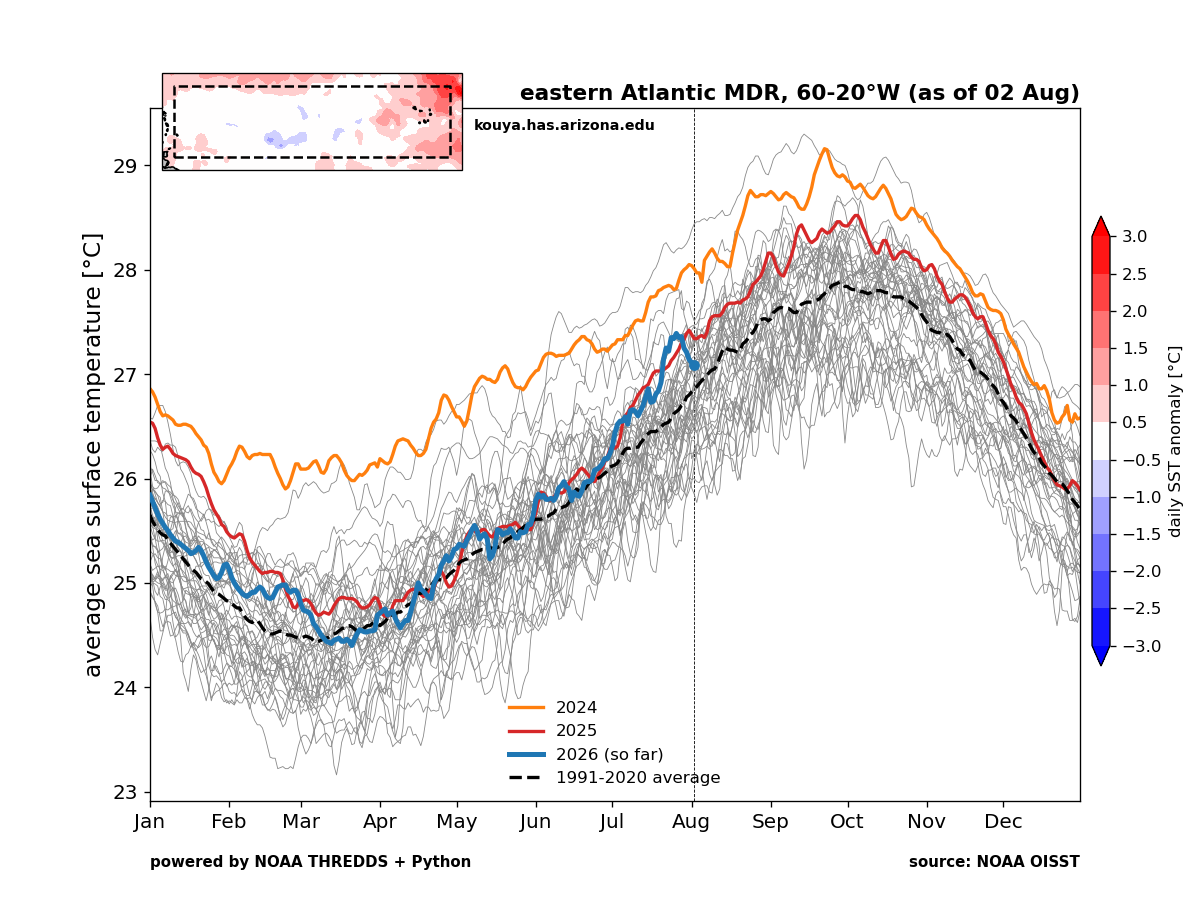
Oceanic heat content is always high in the Caribbean, but this year it’s very, very high.

Oceanic heat content anomaly in the Caribbean is the third highest we’ve seen this late in the season. (Brian McNoldy, University of Miami)

In fact, based on Argo buoy temperature reports from the Caribbean, 30°C water extends down about 180 feet below the surface of the Caribbean. It’s deep, rich, warm water. Particularly if for some reason this ends up west of Jamaica, the oceanic heat content there is incredibly high.

Truthfully, the only things that may inhibit intensification of Melissa is land and time. Wind shear is always a concern, but frankly, there’s nothing that stands out dramatically right now, certainly nothing that says this will falter. If Melissa drifts west to south of Jamaica where that patch of extreme oceanic heat content lies, we could easily be talking a category 4 or 5 storm.

Extreme levels of oceanic heat content exist south of Jamaica, possibly on the path of Melissa. (Brian McNoldy, University of Miami)

So steady intensification is likely for Melissa over the next couple days. Odds of rapid intensification upwards of 75 mph in the next 3 days are almost 5 times normal. Bottom line: There is likely to be continued intensification of Melissa and based on the track, the ceiling could be extremely high.

Rain forecast

Regardless of the track and intensity, someone, perhaps a lot of folks will see heavy, heavy rainfall in the Caribbean.

The rainfall forecast through Sunday shows upwards of a foot of rainfall for eastern Jamaica, as well as the south coasts of Haiti and the Dominican Republic. (NOAA WPC)

When all is said and done next week, it is not out of the realm of the possible for some places to see 20 inches (500 mm) or more of rainfall. This could be catastrophic in some places, including portions of Jamaica and Haiti or the southern Dominican Republic as well. Just really bad news with a slow-moving Melissa.

In summary:

  • Melissa is going to move slowly over the next 5 to 7 days over some of the warmest, deepest warm water in the Atlantic Basin.
  • Intensification into a hurricane and major hurricane seems likely at this point, with a high-end category 4 or 5 in the realm of the possible.
  • Impacts may be severe depending on the exact proximity of the storm to Haiti and Jamaica.
  • Heavy rain, flooding, mudslides, and severe water impacts are possible, if not likely in portions of Jamaica, Haiti, and the Dominican Republic.
  • All areas in this region should be prepared for multiple days of high-end impacts.
  • The storm is not expected to threaten the US, but it will eventually turn north and northeast into the Atlantic, possibly impacting the Bahamas or Turks and Caicos Islands on the way out.

More to come on this, possibly later if time allows.

On the cusp of Melissa, a potentially serious storm is on tap for parts of the central and western Caribbean

In brief: Invest 98L should become Tropical Storm Melissa by later today. It is going to slam on the brakes and meander in the central Caribbean for several days, with potential to become a strong hurricane. It will also be a tremendous rainmaker for somewhere, depending on exactly where it stalls out. Interests from Jamaica and Cuba, across Hispaniola, and into western Puerto Rico should continue monitoring Invest 98L.

Invest 98L is on the cusp of becoming a defined entity this morning.

Invest 98L is about to cross the threshold from Invest to depression or storm. (Weathernerds.org)

NHC odds are up to 100 percent for development, which based on the 4 semesters of Calculus I took in college, don’t get any higher.

Over the next few days there should not be a whole lot to interfere with 98L’s organization. In general, we should see slow, steady development. There’s been no real significant change in SHIPS model guidance for rapid development, showing about a 4.5x chance of that compared to climatology over the next 3 days, mostly unchanged from Monday.

One inhibiting factor to 98L’s growth and development may be the presence of dry air on the west side of the system.

European model forecast of dry air on Thursday, showing quite a bit of it on the north and west side of the system. (Tropical Tidbits)

I guess the question is whether the core of 98L can insulate itself enough from this to more rapidly develop, whereas the broader circulation of the system may be a little lopsided and skewed to the east of the center. We’ll see about that.

So with all that being said, what happens here? In terms of track and path forward, it appears that slower guidance may win out. Steering currents look meager at best, and 98L will probably be drifting westward now. Over the next 36 to 48 hours, agreement is decent in having a developing system drifting west or west-northwest to a position a few hundred miles southeast of Jamaica. From there, we stretch things out.

A fairly wide spread in possible outcomes by Friday evening in the Caribbean. (Google Weather Lab)

Now, that said, the red hot Google AI model seems to favor a position mostly south of Haiti, while the historically decent European ensemble is much more strung out between the Colombian isle of San Andres and the Turks and Caicos Islands. But even the AI modeling sees a widening spread in outcomes beyond Friday. A couple things do stand out in the model guidance today, the signal in the noise if you will. First, slow movement. The system is going to meander it appears, and I think the idea of a rapidly turning and moving storm into the Turks and Caicos by Friday or Saturday is unlikely at this point. Second, intensification. It would seem that with slower movement over a toasty Caribbean will produce steady intensification over the next 5 days. Rapid intensification is possible. We could be looking at a major hurricane by the weekend sitting somewhere south of Hispaniola or southeast of Jamaica.

An aspect that needs to be addressed? Rainfall. The stall position will have a tremendous impact on how much rain falls in parts of the Caribbean. For example, the European model stalls the storm east of Jamaica and drifts it west through day 7. Thus, you see a substantial amount of rain (8 to 12 inches or 200-300 mm) in eastern Jamaica, southern Haiti, and the southern Dominican Republic. If the storms stalls closer to Hispaniola, you could be talking 15 to 20 inches of rain or more in spots there.

Regardless of development, this looks like a potentially massive rain event for portions of the Caribbean. (Weathernerds.org)

So, I think we need to prepare for the potential for severe flooding and mudslide issues in parts of the central and western Caribbean by this weekend.

Bottom line today? Expect a tropical storm (Melissa) by later today. A slow moving storm is likely in the Caribbean. It is possible that a major hurricane can form from this. Regardless of development, major rains are possible, if not likely in portions of the Caribbean, particularly for eastern Jamaica, eastern Cuba, and Hispaniola. Eventually, this system should track north and east out of the Caribbean and into the open Atlantic, but that may not be until next week sometime.